







Balloon Game Prediction
What Is Balloon Game Prediction?
Balloon Game prediction refers to attempts to estimate how a round may develop, particularly the multiplier at which an inflating balloon will pop. In crash-style games, this question attracts attention because the multiplier can increase while the round remains active, creating a decision about when to cash out.
Players may look at previous results, compare multiplier values or search for a balloon prediction tool that claims to identify upcoming outcomes. However, it is important to distinguish between analysing available information and knowing what will happen in the next round.
In games that use random or independently generated outcomes, previous rounds do not provide a dependable way to identify the next result. A prediction should therefore be treated as an estimate or an unverified claim, not as a guaranteed signal.
This page explains how balloon game prediction methods are discussed, what probability means in this context and why exact predictions have important limitations. If you are unfamiliar with the gameplay itself, start with our Online Balloon Game guide.
How Balloon Game Predictions Work
A balloon game predictor is generally presented as a tool or method that analyses information and produces an estimated outcome. Depending on the source, it may use previous multipliers, statistical calculations, visual patterns or other data.
There is an important difference between describing historical information and predicting a future event. A tool can organise previous results or calculate statistics from a dataset. That does not establish that it can accurately determine when an upcoming balloon will pop.
Some websites and applications advertise balloon crash prediction features, including suggested multipliers or signals for upcoming rounds. Before trusting such claims, users should consider whether the method is transparent, independently tested and supported by sufficient evidence.
A prediction interface may display a number, a colour, a suggested cash-out point or a confidence percentage. These visual details should not automatically be interpreted as proof of accuracy.
The following distinctions are useful when evaluating prediction claims:
| Prediction approach | What it may provide | What it cannot establish by itself |
| Previous results analysis | A record of earlier round outcomes | The exact result of the next round |
| Statistical summary | Frequencies, averages and distributions in a dataset | A guaranteed future multiplier |
| Pattern identification | Similarities between recorded outcomes | That the same sequence will repeat |
| Prediction application | An estimated value or signal | Verified accuracy without independent testing |
A credible explanation should make clear what data is being analysed and what limitations apply. Claims of guaranteed results or risk-free predictions deserve particular caution.
Understanding Balloon Game Multipliers
The multiplier is central to most crash-style Balloon Games. It represents the factor used to calculate the gross return when a player successfully completes a cash-out before the balloon pops.
For example, if a hypothetical stake is ₹100 and a cash-out is successfully completed at 1.80x, the illustrative gross return is ₹180. The difference between the return and the original stake is ₹80, before any applicable platform-specific conditions.
A balloon multiplier prediction usually attempts to estimate how high this value may rise before the round ends. However, seeing a multiplier increase does not reveal how much longer the balloon will remain inflated.
It is useful to understand three separate concepts:
- Current multiplier: the value currently displayed during an active round.
- Cash-out multiplier: the value recorded when a cash-out request is successfully accepted.
- Crash multiplier: the point at which the round ends because the balloon pops.
These values describe different stages of the same round. A player cannot assume that the current multiplier will continue increasing or that a particular target will be reached.
For a practical explanation of the controls and multiplier calculation, see How to Play Balloon Game.
Can You Predict When a Balloon Will Pop?
The next balloon prediction is one of the most common questions among players. In a crash-style format, the balloon can pop at different multiplier values, and the exact outcome is not normally visible to the player in advance.
Whether an outcome can be predicted depends on the underlying game design and the information available. If a game uses a randomised outcome mechanism, observing the animation or reviewing earlier rounds does not reveal the result of a future round.
Some games may provide technical information about their outcome-generation systems or verification features. Such information should be assessed according to the actual provider's documentation. It should not be assumed that every Balloon Game uses the same mechanism.
Be cautious with any balloon crash predictor that claims to know the exact pop point. A displayed prediction is not evidence that the tool has access to the game's internal outcome process.
It is also important to distinguish between a prediction made before a round and a description of an outcome after it has occurred. The latter is historical information, not proof of predictive ability.
Balloon Game Probability Explained
Balloon game probability describes the likelihood of possible outcomes under a defined mathematical model. To calculate meaningful probabilities, it is necessary to understand the rules and mechanics used by the particular game.
For example, knowing that a multiplier reached 2.00x in several previous rounds is not enough to calculate the probability that the next round will reach the same value. A reliable calculation would require relevant information about the outcome distribution and how the game generates results.
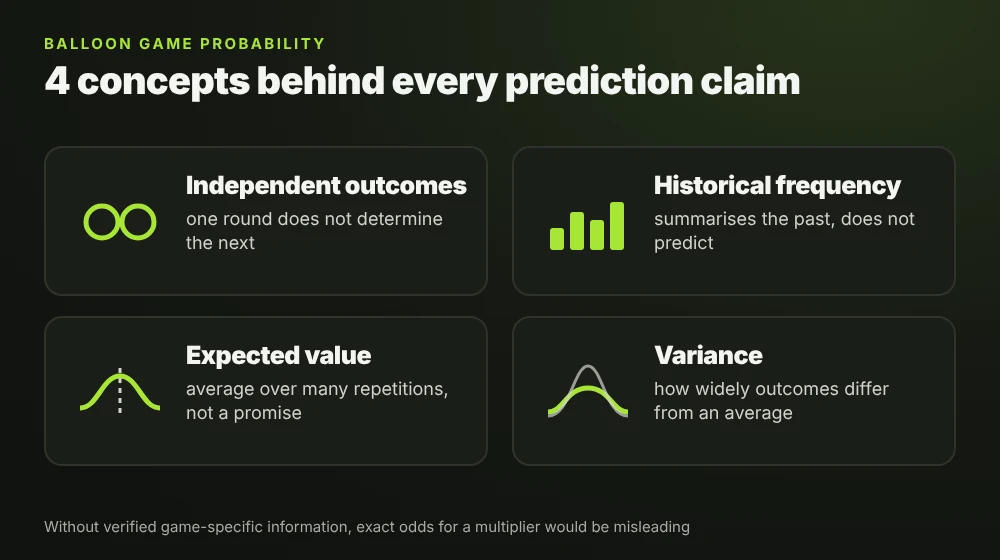
Several concepts are particularly important:
Independent outcomes: If rounds are independently generated, the result of one round does not determine the result of the next. A series of low multipliers does not automatically make a high multiplier more likely.
Historical frequency: This describes how often an event appeared in a recorded dataset. It can summarise the past but does not necessarily predict what will happen next.
Expected value: This is a mathematical measure of average outcomes over many repetitions under specified assumptions. It is not a promise of what an individual player will receive.
Variance: This describes how widely outcomes can differ from an average. Two games or datasets with similar average results may have very different distributions.
Without verified game-specific information, it would be misleading to publish exact balloon prediction probabilities or claim that a particular multiplier has a guaranteed chance of occurring.
Previous Balloon Game Results
Balloon game previous results can be useful for understanding how the interface presents completed rounds. Many platforms include a history panel that records earlier multipliers or other round information.
A history screen may help users:
- Review completed rounds and their displayed outcomes.
- Understand how multiplier values are presented.
- Compare results across a recorded period.
- Become familiar with the game's interface and terminology.
However, historical information has limitations. It may cover only a limited number of rounds, and it does not necessarily explain the full mathematical distribution behind the game.
A list of previous results should not be interpreted as a sequence of instructions for future participation. For example, a high multiplier appearing after several low results does not establish a repeating pattern or a rule that can be used in the next round.
It is also worth checking what the history panel actually records. Some interfaces may show only selected results, while others may present additional round details. The available information depends on the provider.
Balloon Game Patterns and Trends
Searching for balloon game patterns is a common way to explore previous outcomes. Players may compare short sequences, look for repeated multiplier ranges or try to identify periods in which the balloon appeared to pop earlier or later.
These observations can describe a dataset, but they should not be confused with a reliable prediction method. Random variation can produce apparent patterns even when no useful predictive relationship exists.
For instance, a sequence of similar multipliers may look meaningful when viewed on a small screen. Yet a short sequence is not enough to establish that the same values will appear again.
When examining balloon prediction patterns, consider the following questions:
- How many rounds are included in the dataset?
- Are all results recorded, or only selected examples?
- Is the analysis based on actual recorded outcomes?
- Does the suggested pattern have a transparent mathematical explanation?
- Has its predictive performance been tested on separate, previously unseen results?
A pattern that only appears to work when looking backwards may not provide useful information about future rounds. This is why claims based on screenshots, selected examples or isolated winning sequences should be treated cautiously.
Is There a Reliable Balloon Game Prediction Method?
There is no universal balloon game prediction method that can guarantee the next multiplier or identify the exact moment a balloon will pop across different platforms.
A statistical model can analyse available information and produce estimates when sufficient data and a valid mathematical model exist. However, an estimate is not the same as certainty. Its usefulness depends on the quality of the data, the assumptions behind the model and whether those assumptions match the actual game.
Searches for balloon game prediction today may lead to websites, applications or social media channels offering signals and suggested cash-out values. Before relying on any such service, users should consider whether it explains its methodology and provides independently verifiable evidence.
A few warning signs deserve attention:
- Promises of guaranteed multipliers or consistent profits.
- Requests for account credentials, passwords or sensitive payment details.
- Claims that a tool can bypass or control the game's outcome mechanism.
- Results presented only through selected screenshots without a complete record.
- Pressure to pay for a prediction service based on claims of guaranteed success.
No prediction app should be treated as a substitute for understanding the game's rules or the financial risks involved. A tool that displays a suggested number does not remove the possibility of losing a stake.
Common Prediction Myths
Balloon game prediction tricks are often presented as simple ways to identify the next outcome. Some rely on misunderstandings of probability, while others use confident language without providing evidence.
Myth 1: Several low results mean a high multiplier is due.
A sequence of previous outcomes does not guarantee that the next round will produce a different result. This assumption is commonly associated with the gambler's fallacy.
Myth 2: A balloon always follows a repeating multiplier pattern.
Similar-looking sequences can occur by chance. Without evidence of a consistent and exploitable relationship, a repeated pattern should not be treated as a prediction rule.
Myth 3: A prediction application can guarantee the next result.
An application may generate estimates, but a prediction is not proof of access to the underlying outcome mechanism. Guaranteed-result claims require strong, independently verifiable evidence.
Myth 4: Watching the balloon animation reveals when it will pop.
The visual animation shows the current state of the round. It does not necessarily expose the internal outcome or provide a reliable warning before the round ends.
Myth 5: A winning prediction proves that a tool is accurate.
One correct estimate does not demonstrate consistent performance. Evaluating a prediction method requires a complete record, clear testing conditions and enough observations to assess its accuracy.
Understanding these myths helps separate genuine information about gameplay from unsupported promises. For a broader discussion of approaches and risk management, visit the Balloon Game Strategy Guide.
Frequently Asked Questions
Can I predict the next Balloon Game result?
There is no dependable way to identify the exact next result from previous multipliers alone. The outcome depends on the mechanics of the particular game, and historical results should not be treated as guaranteed signals.
Is there a Balloon Game prediction today?
Some websites and applications publish daily estimates or suggested multipliers. These are predictions rather than confirmed outcomes. Their accuracy should not be assumed without transparent and independently verifiable testing.
What is a balloon game predictor?
A balloon game predictor is a tool or method that attempts to estimate a future multiplier or round outcome. It may analyse historical data or use a statistical model, but its output does not guarantee what will happen.
Are balloon crash prediction apps accurate?
Accuracy depends on the application's methodology, data and testing. A prediction displayed on a screen is not sufficient evidence of reliability, especially when the application promises guaranteed results.
Do previous balloon game results affect the next round?
In games where rounds are independently generated, previous results do not determine the next outcome. A history panel records past events but does not establish what will happen in a future round.
Can I use multiplier patterns to improve prediction?
Patterns can be identified in historical datasets, but that does not mean they will repeat. Short sequences and visual similarities are not reliable proof of a predictive relationship.
Is a higher multiplier more difficult to reach?
A higher multiplier represents a larger value in the payout calculation, but the likelihood of reaching it depends on the game's outcome distribution. Exact probabilities should not be assumed without verified information about the particular game.
Does a Balloon Game prediction app guarantee profit?
No prediction app should be considered a guarantee of profit. Real-money gameplay involves a risk of loss, and users should be cautious of services promising certain wins or guaranteed returns.
Where can I learn the rules before playing?
Read the step-by-step Balloon Game tutorial to understand the round sequence, multiplier and cash-out process. You can also explore the Balloon Game Demo guide if a demo mode is available on the platform you choose.