







Balloon Game Strategy
Understanding Balloon Game Strategy
A Balloon Game strategy is a way of approaching the gameplay with a clear understanding of its mechanics, possible outcomes and financial risks. In crash-style versions, the central decision usually involves choosing when to cash out while the balloon is inflating and the multiplier is increasing.
Unlike traditional games that may reward specific combinations or completed levels, a multiplier-based Balloon Game revolves around the relationship between the current multiplier and the moment a round ends. Players may consider different approaches, but none can guarantee a particular result.
A useful starting point is to separate what can be controlled from what cannot. Players can decide whether to participate, how much they are prepared to risk and whether to cash out when the option is available. They cannot reliably determine when the balloon will pop.
This guide examines common approaches, probability concepts and the limitations of popular balloon game tips. For an introduction to the mechanics, see our Online Balloon Game guide.
How Balloon Game Strategies Work
Most balloon game tactics focus on managing decisions during a round. The main difference between strategies is usually the approach to cash-out timing, rather than any ability to control the balloon's inflation or predict the result.
Some players prefer to end their participation at relatively low multipliers, while others choose to remain in a round for a longer period. These approaches reflect different levels of risk exposure, but neither changes the underlying uncertainty of the game.
A strategy can help organise decisions, but it should not be confused with a prediction system. In particular, a sequence of previous results does not establish that a particular multiplier will be reached in the next round.
When reviewing balloon game strategies, consider three separate questions:
- What decision is the approach intended to organise?
- What happens if the round ends before the planned cash-out?
- Does the approach depend on an assumption that cannot be verified?
Understanding these points makes it easier to evaluate a strategy without treating it as a guaranteed way to achieve a positive result.
Understanding Multiplier-Based Gameplay
The multiplier is one of the most important elements of a crash-style Balloon Game. It represents the factor applied to a stake when a cash-out is successfully completed, subject to the platform's rules.
For example, if a hypothetical stake is ₹100 and a player successfully cashes out at 1.40x, the illustrative gross return is ₹140. This calculation does not mean that reaching 1.40x is guaranteed or that the player will necessarily be able to complete a cash-out at that exact point.
A balloon multiplier strategy often focuses on selecting a preferred multiplier at which to stop participating. However, choosing a target does not influence when the balloon pops.
| Multiplier approach | General idea | Important limitation |
| Lower target | Aim to cash out earlier in a round | The balloon can pop before the target is reached |
| Moderate target | Choose a point between lower and higher targets | There is no guarantee that the selected point will be reached |
| Higher target | Remain in the round for a potentially larger multiplier | A longer period of exposure may result in losing the stake |
| No fixed target | Make decisions based on the current round | Decisions can become inconsistent without clear limits |
The multiplier should always be interpreted within the specific game's rules. Some platforms may also have different settlement conditions, so the displayed value alone does not explain every aspect of a payout.
To understand the calculation and the cash-out process in more detail, read How to Play Balloon Game.
Low and High Multiplier Approaches
Low and high multiplier strategies are two commonly discussed approaches to crash-style gameplay. They differ mainly in the point at which a player intends to cash out.
A low multiplier strategy involves setting a relatively modest target and attempting to end participation earlier. Its appeal is the shorter intended duration of each round, but a low target does not remove the possibility that the balloon will pop before the target is reached.
A high multiplier strategy involves remaining in a round for longer in the hope of reaching a larger multiplier. Although the potential gross return at a higher multiplier is greater for the same stake, the balloon may pop before the player completes a cash-out.
Neither approach should be described as the best balloon game strategy for every player. The appropriate way to assess them is to understand their different risk profiles rather than assume one consistently produces better results.
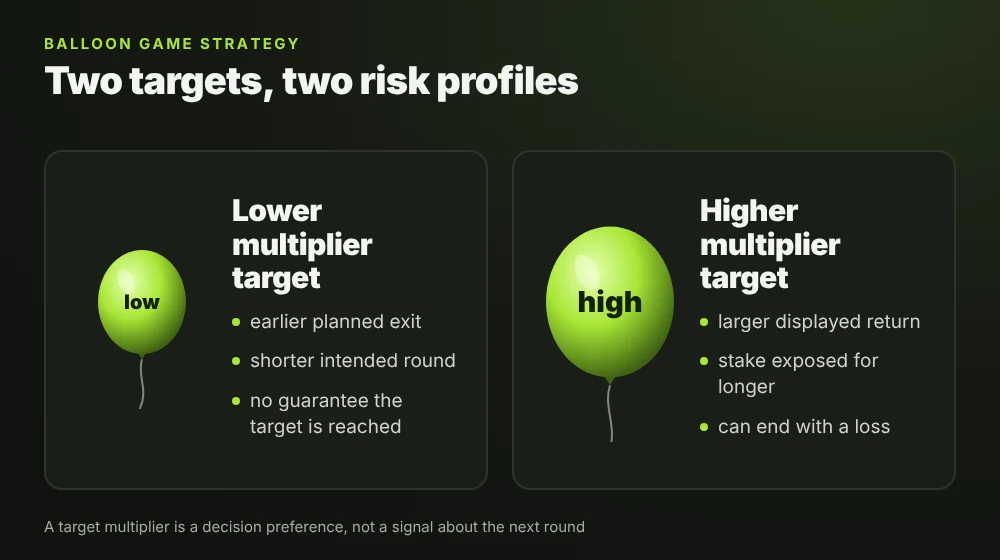
The following comparison summarises the main considerations:
- Lower multiplier target: focuses on an earlier planned exit, but does not guarantee that the target will be reached.
- Higher multiplier target: aims for a larger displayed return, but keeps the stake exposed for longer and can end with a loss.
A target multiplier is a decision preference, not a signal about the future outcome of a round.
Understanding Risk and Probability
Balloon game risk management begins with recognising that each round has an uncertain outcome. In many crash-style formats, the player does not know in advance when the balloon will pop.
Probability describes the likelihood of possible outcomes within a defined mathematical model. However, calculating an accurate probability for a particular multiplier requires information about the game's underlying rules and mechanics. Without that information, assigning exact odds or claiming that a specific target is statistically favourable would be misleading.
It is also important to distinguish between the size of a possible return and the likelihood of achieving it. A higher multiplier can produce a larger gross return when successfully reached, but this does not mean it is easier or more likely to achieve.
Responsible risk management can involve setting limits before participation:
- Decide on a maximum amount that can be lost without affecting essential expenses.
- Set a time limit and stop when it is reached.
- Never increase a stake to recover money lost in earlier rounds.
- Avoid borrowing money or using credit to continue playing.
- Stop if gameplay begins to cause stress, financial pressure or difficulties with everyday responsibilities.
These measures do not improve the probability of a winning outcome. Their purpose is to limit potential harm and prevent uncontrolled spending.
Can Previous Rounds Help Build a Strategy?
Many players examine previous balloon game results to look for patterns. A round history may display a sequence of multipliers or show where earlier balloons popped. This information can describe what has already happened, but it should not be treated as a reliable forecast.
For example, if several rounds end at relatively low multipliers, it does not prove that the next round will reach a higher one. Likewise, a sequence of high results does not establish that a low result is due.
The idea of identifying balloon game patterns can be misleading when players assume that random or independently generated outcomes must follow a particular short-term sequence. Past results alone do not establish the probability of the next outcome.
There is also a difference between reviewing data and predicting an event. A history screen can help someone understand the interface and examine previous rounds, but it does not necessarily provide enough information to calculate future results.
For a closer look at historical outcomes and prediction limitations, visit the Balloon Game Prediction page.
Common Balloon Game Strategy Mistakes
A strategy becomes unreliable when it is based on assumptions about the next round rather than a realistic understanding of the game. Some mistakes are related to multiplier selection, while others involve spending decisions and emotional reactions.
Common balloon game strategy mistakes include:
- Assuming that a balloon must reach a higher multiplier after several low results.
- Increasing the stake after a losing round in an attempt to recover the previous loss.
- Treating a cash-out target as a guaranteed result.
- Following online tips that promise signals, fixed patterns or consistent profits.
- Ignoring the rules and settlement conditions of the selected platform.
- Continuing to play after reaching a personal spending or time limit.
Another common mistake is confusing a structured approach with an advantage over the game's mechanics. A predefined target can make decisions more consistent, but it does not change the uncertainty of the round.
Beginners should first learn the controls and understand what happens when a balloon pops. The Balloon Game Demo guide explains how a demo mode can help users become familiar with the interface where such a mode is available.
Balloon Game Strategy Myths
The popularity of multiplier-based games has led to many claims about balloon game tricks and methods for identifying the right cash-out moment. Some of these claims are based on misunderstandings of probability, while others present unsupported predictions as proven techniques.
Consider these common myths:
Myth 1: A sequence of low multipliers means a high multiplier is coming.
Previous outcomes do not guarantee a particular next result. A new round should not be treated as compensation for earlier results.
Myth 2: There is a universal cash-out multiplier that always works.
No single target can guarantee a successful cash-out. The balloon may pop before any chosen multiplier is reached.
Myth 3: A special timing technique can prevent the balloon from popping.
The player's timing decision does not control the underlying round outcome. A cash-out request must also be accepted before the round ends.
Myth 4: More rounds always create a better chance of recovering losses.
Playing additional rounds means taking part in more uncertain events. It does not guarantee that previous losses will be recovered.
Myth 5: Prediction tools can identify the exact result of every round.
Claims of guaranteed signals or exact predictions should be treated with caution, particularly when there is no transparent and independently verifiable evidence.
Useful balloon game tips should explain the rules, clarify uncertainty and encourage responsible decisions. They should not promise guaranteed income or present speculation as a mathematical advantage.
Responsible Gaming and Spending Limits
A balloon game strategy should always include limits on participation. In real-money versions, every stake carries a risk of loss, regardless of the multiplier target or the approach being followed.
Before playing, consider whether the activity is affordable and permitted under the rules that apply to your location. Requirements for online gambling can differ across jurisdictions and within India, including between states. Users should check the applicable local requirements rather than assume that every platform is legally available.
A practical approach to responsible gaming includes:
- Using only money that is not needed for rent, food, bills, savings or family responsibilities.
- Establishing a strict spending limit before opening the game.
- Avoiding gameplay when tired, upset, under pressure or affected by alcohol.
- Taking a break instead of trying to recover losses.
- Using available account limits, time controls or self-exclusion tools where appropriate.
If gambling starts affecting finances, relationships, work or mental well-being, stopping and seeking professional support is more important than finding another strategy. A game should never be treated as a way to repay debts or solve financial difficulties.
Frequently Asked Questions
What is the best Balloon Game strategy?
There is no universally best strategy that guarantees a positive result. Different approaches focus on different cash-out targets, but all remain exposed to the uncertainty of when the balloon will pop.
Do balloon game tricks really work?
Claims about guaranteed tricks, exact signals or methods that prevent a balloon from popping should be treated sceptically. Understanding the rules and setting limits are more reliable ways to approach the activity than following unsupported claims.
Is a low multiplier strategy safer?
A lower target may involve an earlier intended cash-out, but it does not guarantee that the target will be reached. The balloon can pop before a successful cash-out at any selected target.
Is a high multiplier strategy better?
A higher multiplier can produce a larger gross return if it is reached and a cash-out is accepted. However, remaining in a round for longer also exposes the stake to the possibility of losing it. A higher target is not automatically a better choice.
Can I predict when the balloon will pop?
There is no reliable way for a player to predict the exact pop point from previous round results alone. Any claim of guaranteed prediction should be viewed with caution.
Does changing my stake affect the multiplier?
A stake determines the amount used in the payout calculation. It does not necessarily influence the multiplier or determine when the balloon pops. Exact mechanics depend on the provider.
Can beginners use a Balloon Game strategy?
Beginners can learn the available controls, understand multiplier calculations and establish personal limits. These steps help with informed participation but do not create a guaranteed advantage.
Where can I learn more about Balloon Game mechanics?
Start with the Balloon Game Strategy Guide and the step-by-step gameplay tutorial. These resources explain the basic mechanics, cash-out process and limitations of common gameplay approaches.