







How to Play Balloon Game
Getting Started with Balloon Game
If you are new to this type of game, understanding the basic rules is the best place to begin. A crash-style Balloon Game usually centres on a simple sequence: a round starts, a balloon begins to inflate, the displayed multiplier may increase, and the player decides whether to cash out before the balloon pops.
The objective is to understand how each stage works rather than assume that the balloon will continue growing for a predictable amount of time. Every round can end at a different point, and a previous result does not reveal what will happen next.
Before starting, take a moment to explore the available controls and read the rules provided by the game platform. Some versions offer different settings, interfaces or play modes, so the exact experience may vary.
This balloon game guide is designed for beginners who want to understand the gameplay process. For a broader introduction to the format and its features, visit the Online Balloon Game homepage.
Understanding the Game Interface
The balloon game interface is where the main gameplay information and available controls are displayed. Although the design can differ between providers, crash-style versions commonly include a central balloon animation, a multiplier indicator and controls for participating in a round.
The balloon game screen may contain the following elements:
| Interface element | What it shows |
| Balloon area | Displays the balloon as it inflates during the round |
| Multiplier | Shows the current multiplier, where supported |
| Stake field | Allows the player to enter a stake in real-money modes |
| Start or Play button | Begins participation in a round |
| Cash-out control | Allows an active player to collect the displayed return before the round ends |
| Round history | May display outcomes from previous rounds |
| Settings | May contain sound, display or gameplay options |
Not every platform includes all these elements. Some interfaces combine controls or use different labels, so it is important to check what each button does before interacting with it.
Pay particular attention to the difference between starting a round and confirming a cash-out. These actions have different purposes, and their availability may depend on the current game state.
How to Start a Balloon Game Round
Starting a round generally involves opening the game, reviewing its rules and selecting the available play settings. In versions that use stakes, the player may also need to enter an amount before joining.
A typical starting process looks like this:
- Open the Balloon Game and wait for the interface to finish loading.
- Review the displayed instructions, available controls and round conditions.
- If the game uses stakes, enter an amount within the permitted limits.
- Select the relevant Play, Start or participation control.
- Wait for the round to begin and follow the on-screen multiplier and balloon animation.
The exact sequence can vary. For example, some games allow a player to prepare a stake before a round begins, while others use a separate confirmation step. Demo versions may also start rounds without requiring a real-money stake.
Once a round is active, focus on the current game state. Do not assume that the next round will follow the same timing or outcome as the previous one.
How to Inflate the Balloon
Balloon inflation is the central visual mechanic in this game format. During an active round, the balloon expands on the screen while the multiplier may rise alongside it.
The phrase how to inflate a balloon in game can describe different mechanics depending on the provider. In many crash-style versions, inflation happens automatically after the round starts. The player does not need to repeatedly tap the balloon or control its size manually.
Other balloon-themed games may use tapping, clicking or holding controls to inflate or pop a balloon. These are different gameplay formats and should not be confused with a multiplier-based crash game.
For a typical automatic-inflation version, the process is straightforward:
- Start or join an available round.
- Observe the balloon as its animation progresses.
- Follow the multiplier displayed by the interface, if one is provided.
- Use the available cash-out control if you decide to end your participation before the balloon pops.
The animation represents the progress of the round, but it should not be treated as a signal that guarantees how much further the balloon will inflate.
How Does the Multiplier Increase?
The balloon game multiplier indicates how the displayed return changes during an active round. In a crash-style format, it generally begins at an initial value and increases while the balloon continues to inflate.
For example, imagine a hypothetical game with a stake of ₹100. If the displayed multiplier reaches 1.50x and a valid cash-out is completed at that point, the illustrative gross return would be ₹150, before considering any platform-specific conditions.
The basic calculation is:
Illustrative return = Stake × Cash-out multiplier
| Stake | Example multiplier | Illustrative gross return |
| ₹50 | 1.20x | ₹60 |
| ₹100 | 1.50x | ₹150 |
| ₹200 | 2.00x | ₹400 |
These figures explain the multiplication process only. They are not advertised payouts, guaranteed results or a prediction of future multipliers. Actual terms, rounding, limits and settlement rules depend on the specific game.
A higher displayed multiplier does not mean that the round is safer or that a particular outcome is approaching. The balloon can pop at an unpredictable point, and the player may lose the stake if the round ends before a successful cash-out.
How to Cash Out in Balloon Game
Cash-out is the action used to end participation in an active crash-style round and secure the return associated with the multiplier at the moment the request is accepted.
Understanding how to cash out balloon game correctly is important because the available time can be limited. The control may be labelled Cash Out, Collect or something similar, depending on the provider.
A typical cash-out process includes these actions:
- Check that the round is active and the cash-out control is available.
- Review the current multiplier shown on the screen.
- Select the cash-out control when you decide to finish the round.
- Wait for the interface to confirm whether the action was accepted.
- Check the displayed result or account balance after settlement.
The timing of a cash-out request matters. If the balloon pops before the platform accepts the action, the round may end without a successful collection. Network delays, interface response times and provider-specific rules can also affect how an action is processed.
Some games offer automatic cash-out settings, but their availability and operation are not universal. If such a feature exists, read its instructions carefully before using it. Automatic settings do not eliminate the risk of losing a stake.
For a more detailed discussion of gameplay decisions and risk awareness, see the Balloon Game Strategy Guide.
What Happens When the Balloon Pops?
When the balloon pops, the active round ends. In a typical crash-style game, the multiplier stops increasing and players who have not completed a valid cash-out before the pop may lose their stake for that round.
The result depends on the game rules and the timing of the player's action. A successful cash-out completed before the round ends is generally settled according to the multiplier recorded at that moment. A cash-out attempted after the pop may not be accepted.
It is important to distinguish this mechanic from a traditional balloon pop game. In an arcade-style balloon pop game, popping balloons may be the main objective and can award points or complete a level. In a crash-style Balloon Game, the pop usually marks the end of the multiplier round.
If you want to understand the different types of results and why previous rounds cannot reliably predict future outcomes, read the Balloon Game Prediction Guide.
Understanding a Complete Game Round
A complete round can be understood as a sequence of stages, from preparing to participate to receiving the final result. Knowing this sequence makes it easier for beginners to follow the interface without confusing the balloon animation with the available controls.
In a standard crash-style version, the process can be described as follows:
Preparation → Round begins → Balloon inflates → Multiplier changes → Cash-out or balloon pop → Result is displayed
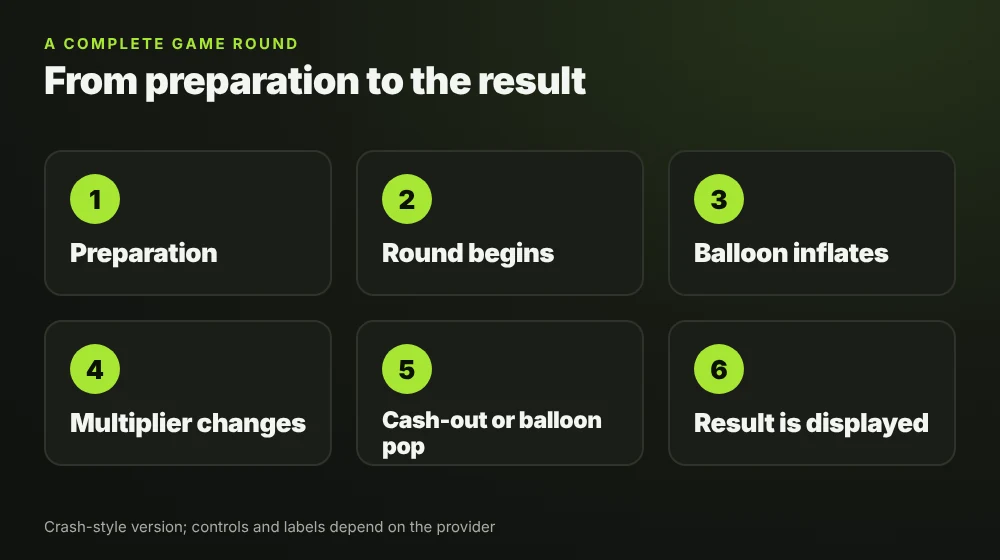
Each stage has a different role. Preparation is where the player reviews the rules and, where applicable, enters a stake. The active phase begins when the balloon starts inflating. During this phase, the displayed multiplier may increase until the player cashes out or the balloon pops.
The final stage records the outcome. The interface may then display the result and prepare for another round.
For beginners, a demo version can provide an opportunity to become familiar with the controls without using real-money stakes, if the selected platform offers one. You can learn more on the Balloon Game Demo page.
Common Beginner Mistakes
New players can misunderstand the mechanics when they focus only on the balloon animation or assume that previous outcomes reveal a reliable pattern. Learning the interface and understanding the limits of the game are more useful than relying on unsupported predictions.
Common balloon game beginner mistakes include:
- Starting without reading the rules: different providers can use different controls, round conditions and settlement procedures.
- Confusing animation with control: in many crash-style games, the balloon inflates automatically rather than responding to repeated clicks.
- Waiting without understanding cash-out timing: the balloon can pop before a cash-out request is accepted.
- Treating previous results as predictions: round history does not guarantee or reliably establish the next outcome.
- Ignoring stake limits: in real-money versions, an amount should be considered carefully before participation.
- Assuming demo results represent real-money conditions: demo and real-money modes may differ in their terms or available features.
A cautious approach means understanding the rules, avoiding assumptions and never treating the game as a source of guaranteed income. If real money is involved, only participate where permitted by applicable local rules and never use money needed for essential expenses.
Frequently Asked Questions
How to play Balloon Game online?
Open a platform offering the game, review its instructions and learn how the interface works. In a typical crash-style version, a round begins, the balloon inflates and the multiplier may increase. The player can attempt to cash out before the balloon pops. Exact controls depend on the provider.
Is Balloon Game easy for beginners?
The basic crash-style mechanic is relatively simple to understand: follow the balloon, observe the multiplier and learn when the cash-out control is available. However, understanding the interface does not make the outcome predictable or remove the risk of losing a stake.
Do I need to inflate the balloon manually?
Not necessarily. Many crash-style versions inflate the balloon automatically after a round starts. Other balloon games may require tapping or clicking, so check the instructions for the specific version you are using.
When should I cash out?
There is no universally correct cash-out moment. The multiplier can change while the round is active, and the balloon may pop before a request is accepted. No strategy can guarantee a successful result.
Can I practise Balloon Game without spending money?
Some platforms provide a demo mode that allows users to explore the interface without placing real-money stakes. Availability and demo conditions vary. Visit the Balloon Game Demo page for more information.
Can I play Balloon Game on a mobile phone?
Some versions are designed to work through mobile browsers or dedicated applications. Compatibility depends on the provider and device. See the Balloon Game App guide for information about mobile access.
Does every Balloon Game have a cash-out feature?
No. Cash-out is associated with certain crash-style versions. Traditional balloon popping and arcade games can use completely different rules and objectives.
Can previous rounds help me predict the next balloon pop?
Previous outcomes do not provide a reliable way to determine when the next balloon will pop. Each round should be treated as a separate event, and historical results should not be considered guaranteed signals.